The first milestone in a cycle of seven cards dedicated to maturity, Justice demands a necessary pause. No more cheating. To grow, we must trade our armour for a set of scales. This absolute commitment to “truth” is not merely a moral virtue but the very engine of the passage into adulthood, where authority no longer comes from others but from an inner rectitude.
1. From the social mask to the throne of truth
In the odyssey of the tarot, the Fool crosses a threshold of consciousness when he encounters Arcana VIII. Until then, under the aegis of the Chariot, our traveller was learning to tame the horses of his will and to forge his “social mask.” It was the time of triumphant adolescence, when armour served to conquer the outer world. But the Chariot, in all its impetuosity, remains turned toward appearances.
The appearance of Justice sounds the death knell of pretence and marks the solemn entry into the second septenary of the major arcana: that of the embodiment of the adult. The first milestone in this cycle of seven cards dedicated to maturity, Justice demands a necessary pause. No more cheating. To grow, we must trade our armour for a set of scales.
This absolute commitment to “truth” is not merely a moral virtue but the very engine of the passage into adulthood, where authority no longer comes from others but from an inner rectitude.
2. The Architecture of the Divine: the geometry of perfection
Arcana VIII tolerates no approximation. Its number, 8, traces through its perfect symmetry the eternal balance of cosmic laws. It is the number of perfection, a mirror in which the above and the below reflect each other without distortion.
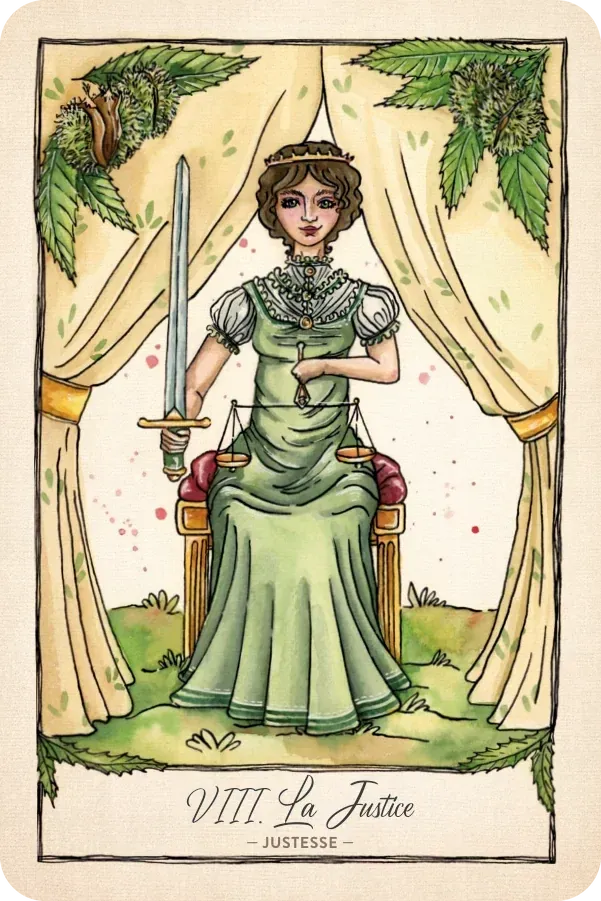
It is essential to note that in the Tarot de Marseille, which we follow here, Justice occupies this eighth position, unlike the Anglo-Saxon Rider-Waite tradition, which places Strength there. At the crossroads, Justice welcomes us with sovereign solemnity. The central figure, a woman whose gaze seems to probe the depths of the soul, sits enthroned with a stability that nothing could shake.
Her attributes are the pillars of her power:
Attribute
The Scales
They do not merely weigh actions but the rightness of intentions, seeking harmony between our desires and reality.
Attribute
The Sword
Symbol of a purified mind, its cold steel sculpts our reality, separating the wheat from the chaff of truth.
Commit yourself to seeking what is just and true, without turning a blind eye.
This demand for perfection is the foundation upon which an authentic life is built, requiring a rigour that transmutes our hesitations into sovereign decisions.
3. The cutting edge of Lucidity: making decisions to find balance
On the stage of the psyche, Justice acts as a catalyst for metamorphosis. Its deepest—and perhaps most demanding—teaching lies in the concept of “giving yourself what you deserve.” Far from being an external sentence, this is a form of responsibility: we are the architects of our own balance, reaping with mathematical precision the fruits of what we have sown.
The process of transformation it demands unfolds as acts of will:
- Distinguishing true from false: dissolving the mirages of limiting beliefs to let the core of our identity emerge.
- The clarity of taking a stand: learning the power of “yes” and the nobility of “no.” Each decision is a stroke of the sword that marks our territory.
- The necessary separation: courageously detaching from the obsolete, whether toxic relationships or parts of ourselves that no longer belong in our adult life.
4. Practical Applications: between guidance and divination
In a reading, Justice delivers answers stripped of ambiguity. It calls for putting things in order, clearing up what is vague, and assuming full sovereignty over one’s existence. In a purely divinatory reading, it often points to State structures, administrative matters, contracts, or legal affairs requiring resolution.
Here is a summary of its meanings to guide your interpretation:
| Positive Vision | Challenges / Shadows |
|---|---|
| Clear thinking: a lucid, unobscured view of the situation. | Rigidity: excessive severity that prevents the flow of life. |
| Balance: harmony restored between heart and reason. | No room for error: the paralysing fear of not being perfect. |
| Integrity: alignment between one’s principles and one’s actions. | Excessive pressure: the crushing weight of judgements and social expectations. |
5. Conclusion: the inner compass of maturity
Ultimately, Justice is not an external tribunal but an inner compass essential to anyone who aspires to maturity. It is the first step toward personal growth, for there can be no growth without truth.
By inviting us to look into the mirror of our soul with unflinching honesty, it offers us the keys to harmony. It teaches us that becoming an adult means no longer submitting to fate but balancing it wisely through the quiet strength of our choices.
Justice teaches us that becoming an adult means no longer submitting to fate but balancing it wisely through the quiet strength of our choices.